
Meditation is one of humanity's oldest practices — a way of turning attention inward to find stillness, clarity, and peace. In a world that pulls us in a thousand directions at once, this ancient tool is more relevant today than ever before.
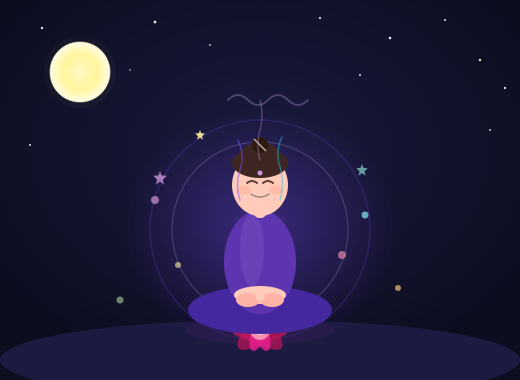
What Is Meditation?
At its simplest, meditation is the practice of training your attention and awareness. It is not about emptying the mind — that is a common myth. Instead, it is about noticing where your mind goes and gently guiding it back, again and again, with patience and without judgment.
Origins: A 3,500-Year Journey
Meditation did not begin in a yoga studio. Its roots stretch back thousands of years across multiple cultures and continents.
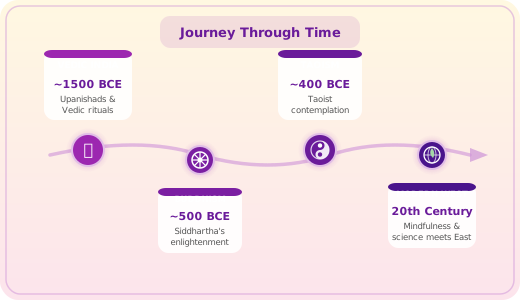
The earliest written records of meditation-like practices appear in the Vedas of ancient India, around 1500 BCE. The word "meditation" derives from the Latin meditatum — "to ponder." Taoist China (~400 BCE) developed its own contemplative traditions, while Buddhist schools from 500 BCE forward made meditation the very core of the path to enlightenment.
In the 20th century, teachers from the East brought these practices to the Western world. Jon Kabat-Zinn developed Mindfulness-Based Stress Reduction (MBSR) in 1979, anchoring meditation in scientific research and transforming it into a mainstream health practice.
What Does Science Say? 6 Proven Benefits
Decades of research have examined meditation's effects on the body and mind. The findings are striking.
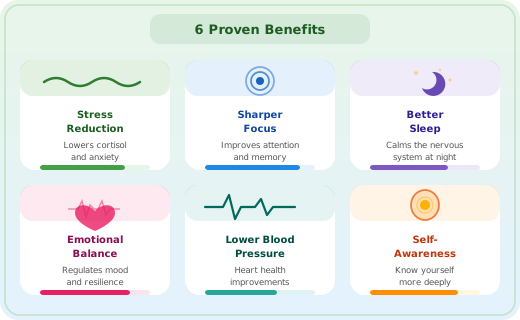
- Reduces stress and anxiety — Meditation lowers cortisol, the primary stress hormone, and calms the fight-or-flight response.
- Improves focus and memory — Regular practice physically thickens the prefrontal cortex, the part of the brain responsible for attention and decision-making.
- Better sleep — Calming the nervous system before bed makes it significantly easier to fall and stay asleep.
- Emotional regulation — Meditators show greater activity in brain areas linked to positive emotion and resilience.
- Lower blood pressure — Multiple studies confirm meditation's positive effect on cardiovascular health.
- Deeper self-awareness — You begin to notice your patterns of thought and reaction, creating space to choose different responses.
How to Start: A Simple Practice
You do not need an app, a cushion, or a quiet room. You need five minutes and a willingness to try.
Step 1 — Find a comfortable position
Sit on a chair with your feet flat on the floor, or cross-legged on the ground. Your back should be upright but not stiff. Rest your hands on your thighs or in your lap.
Step 2 — Anchor your attention on the breath
Close your eyes softly. Take one slow breath in through the nose, and one slow breath out. Notice the physical sensation: the cool air entering, the rise of the chest, the warmth as you exhale.
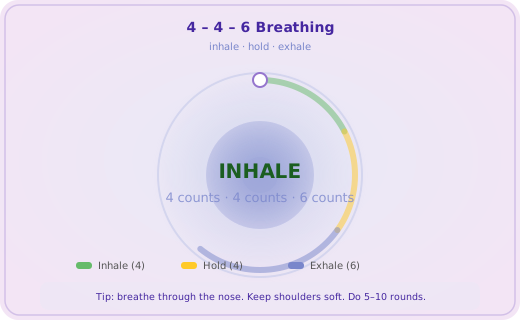
Step 3 — Use the 4–4–6 rhythm (see animation above)
Inhale slowly for 4 counts. Hold gently for 4 counts. Exhale completely for 6 counts. This pattern activates the parasympathetic nervous system — your body's natural calming mechanism. Repeat 5–10 times.
Step 4 — When the mind wanders, simply return
Your mind will wander — guaranteed. That is not failure. The moment you notice the wandering is itself the meditation. Each time you gently return your attention to the breath, you are strengthening the neural pathways of focus and self-awareness.
Step 5 — Build a daily habit
Even five minutes each morning creates measurable change over time. Consistency matters far more than duration. Try pairing your practice with an existing habit — a cup of morning tea, or just before sleep.
A Final Thought
Meditation is not an escape from life — it is a return to it. Through practice, the noise settles, and what remains is a quieter, clearer version of you: more present, more grounded, more alive to each moment as it passes.
If you would like support building a sustainable inner practice alongside your coaching or therapy work, I invite you to reach out. This is exactly the kind of work I love to do with clients.